In-Situ PFv Profiling for Team Sports
A practitioner's guide to tracking force-velocity profiles from GPS data you're already collecting — no extra testing required.
- Builds a force-velocity profile from GPS data you already collect in training and matches, with no extra sprint testing.
- Validated against isolated sprints in sub-elite Gaelic football, with the minimum data needed for a stable profile.
- Sliding-window ballistic power tracks neuromuscular fatigue within a match.
1. What is a PFv profile?
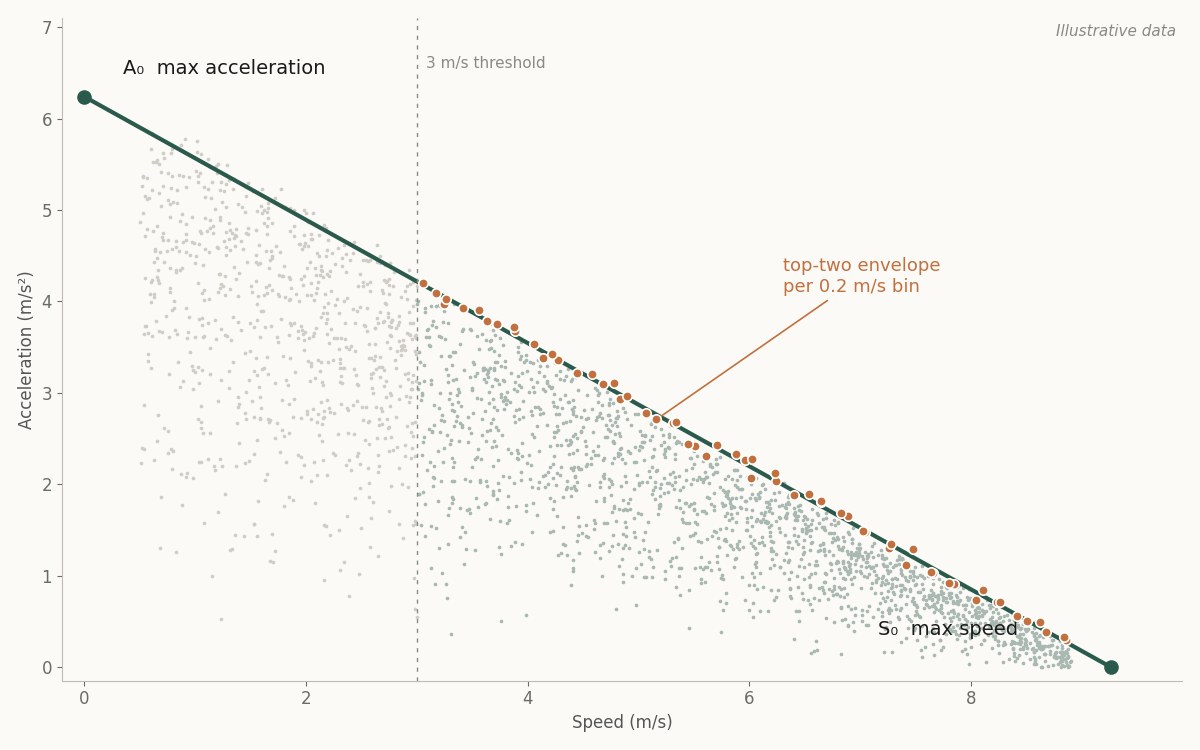
Every time a player accelerates on the pitch, their body is producing force at a given velocity. Plot these two against each other across many efforts and you get a force-velocity (FV) profile [1] — a straight line that describes the trade-off between how hard a player can push (force) and how fast they're moving (velocity) while doing it.
From that single line, you can extract several useful numbers: how explosive a player is from a standing start (A₀), their top-end speed capacity (S₀), their peak power output (Pmax), and a newer metric called ballistic power (PB) which captures the total area under the curve — essentially the full picture of a player's sprint-related output [2].
Traditionally, getting these numbers meant running a dedicated sprint test — timing gates [3], radar guns [4], or a treadmill [5]. The breakthrough described in this study is that you can extract the same profile passively from the GPS data you're already collecting during regular training and matches [6]. No extra sessions, no disruption to the schedule, no additional equipment.
If you're already using GPS units in training and matches, you have everything you need. The method described here turns that data into force-velocity profiles that update automatically — giving you a new lens on player readiness, fatigue, and development without adding a single drill to your programme.
2. Key findings
The study tracked 34 sub-elite Gaelic footballers across a full season (70 training sessions and 18 competitive matches) using 10 Hz STATSports GPS units [7, 17].
Strong linearity
In-situ profiles were highly linear — comparable with existing studies using elite soccer players [6, 8]. Match R² = 0.929, training R² = 0.949.
Minimum data needed
Just 12 minutes of match data reaches R² of 0.9. The geometric "knee" is at 7 minutes — fast enough for in-game monitoring.
In-match power decline
Ballistic power (PB) dropped by an average of 6.4% across a full game — consistent with neuromuscular fatigue [2].
In-situ ≠ isolated sprints
Systematic differences exist. In-situ A₀ is higher, Pmax is lower. Pick one method and stick with it for tracking changes.
3. How the method works
Step 1 — Filter the raw speed
GPS speed data is noisy. The first step is applying a second-order Butterworth low-pass filter with a 1 Hz cut-off [8] to smooth out the high-frequency noise while preserving genuine speed changes.
Step 2 — Derive acceleration
From the filtered speed, acceleration is calculated using central differences [9]. Only data above 3 m/s is kept [6, 18] — below that, players are jogging or walking and the acceleration data isn't meaningful for profiling.
Step 3 — Extract the envelope
The speed range above 3 m/s is divided into 0.2 m/s windows. Within each window, the top two acceleration values are extracted — the "envelope" of what the player can produce [6].
Step 4 — Fit and clean
A linear regression is fitted to these peak points. Any points outside the 95% confidence interval are flagged as outliers and removed. A second regression is fitted to the cleaned data — this is the final acceleration-speed profile.
Step 5 — Extract metrics
| Metric | What it is | Unit |
|---|---|---|
| S₀ | Maximum hypothetical speed (x-intercept) | m/s |
| A₀ | Maximum force / acceleration (y-intercept) | m/s² |
| Pmax | Peak power (maximum of speed × acceleration) | W/kg |
| PB | Ballistic power (area under the FV curve) | W/kg |
| SFv | Slope of the FV line | s⁻¹ |
| dFv | Perpendicular distance from origin to FV line | — |
Pmax is the single highest point on the power curve — peak output. PB is the total area under the force-velocity line, capturing the full range of force-producing ability. The study found PB is the most sensitive metric for detecting neuromuscular fatigue [2].
4. Setting up the pipeline
There are two complementary codebases. The research code contains all the scripts used to generate the paper's figures and results. The practitioner pipeline is an operational tool for processing GPS data session-by-session into a Tableau-ready summary CSV.
Research code architecture
utils.py
Filter, IF selection, AS fitting, outlier rejection
loading.py
CSV parsing, time dedup, session caching
11–24
Profiles, group analysis, data load, fatigue
Figures
Publication-ready figures & processed CSVs
Research code — directory structure
Key processing parameters
FS_DEFAULT = 10              # Sampling frequency (Hz)
CUTOFF_HZ = 1               # Lowpass Butterworth cutoff
FILTER_ORDER = 2             # Butterworth filter order

MINIMUM_SPEED = 3.0          # m/s — threshold for IF selection
BIN_WIDTH = 0.2              # m/s — speed bin width
MAX_ACCEL_THRESHOLD = 12.0   # m/s² — hard ceiling
OUTLIER_SD = 1.96            # 95% CI for outlier rejection

HALF_DURATION_S = 1800       # 30 minutes per half
STEP_S = 10                  # Sliding window step (seconds)
5. Sonra workflow
Download & pre-processing
After each session, download the data via a Single Dock into Sonra. First check for anomalous max speeds — anything above 10 m/s usually indicates a GPS error (verify in the Activity Graph) or someone driving home with the unit still on. Crop all sessions to the same length using Edit Session in the Calendar view, from the start of the warmup to the end of the cool down.
Creating drills
Drills are created in the Activity Graph view. For matches, it's usually straightforward to see where warmup, first half, and second half begin and end. For training, the Session Replay function helps. The Fixed Time Drills function (under Calculations → Segment Drills) is useful for splitting halves into equal blocks.
Exporting
Name sessions consistently — Training or Match. Export through Export Data → Raw Data → Raw Data Extended.
The Raw Data Extended export writes 10 speed values per timestamp (10 Hz device, 1-second time column). The pipeline deduplicates by keeping the first reading per timestamp, giving an effective 1 Hz sample rate. If you're building your own processing code, handle this — otherwise distance metrics will be inflated by ~10×.
6. Try it yourself
Upload a raw STATSports CSV below and the figures from the study will be generated in your browser. Nothing leaves your device — all processing happens locally using the same algorithms described in the paper.
Run the method
The figures below run on a synthetic 30-minute match as soon as you reach them. Drop in your own export to replace it.
Drop a raw STATSports CSV here, or click to browse
Expects columns: Time, Speed (m/s). All processing runs locally.
7. Practical applications
In-match monitoring
With only 7–12 minutes of match data needed [10], it becomes possible to track PFv metrics in near real-time using a sliding window [11]. The study showed PB declined progressively across both halves, with a partial recovery visible after half-time — consistent with neuromuscular fatigue and subsequent partial recovery [2].
If a player's PB trajectory deviates significantly from their typical pattern or drops below baseline more sharply than the rest of the squad, this could flag fatigue, under-recovery, or elevated injury risk [12, 19]. This doesn't replace existing load metrics but adds a richer picture of the force-velocity relationship.
Return-to-play
A training game of sufficient duration (15+ minutes) could provide an in-situ PFv snapshot to compare against a player's pre-injury baseline. While specific thresholds haven't been established yet, this framework provides the foundation for data-informed return-to-play criteria [12].
Training programme evaluation
By tracking PFv profiles longitudinally, you can observe how a player's force-velocity characteristics respond to different training blocks [13]. Changes in the profile's slope can indicate whether a player is becoming more force-oriented or velocity-oriented over time.
These methods are currently best positioned as an additional monitoring signal alongside your existing toolkit. Individual baselines, smallest worthwhile change thresholds, and links with internal load measures need to be established before these can become decision-making tools.
8. What to watch out for
In-situ ≠ isolated sprints. A₀ is consistently higher in-situ (the method selects peak accelerations across many sessions), while Pmax is consistently lower [2]. Pick one method and track changes within it.
Context matters. Match profiles produce higher S₀ values than training profiles [8]. Training profiles converge more slowly (42 minutes vs 12 minutes for matches). The composition of training affects the quality of the profile you can extract.
GPS quality. Monitor satellite count and HDOP values [14]. A 10 Hz sampling rate with 1 Hz Butterworth filter may smooth genuine high-acceleration events [15].
Sample characteristics. This study used one male amateur squad [16]. Results may not fully extend to female athletes, elite professionals, adolescents, or other sports. Validate within your own population.
9. References
- Adrian, M.J. & dos Anjos, L.A. (1986). Profiling. In ISBS Conference Proceedings Archive.
- McGleenan, E., Grant, S.D., McFetridge, L.M., Brown, J.C.J., Shaw, J.W., de Melo Malaquias, T., Montgomery, R. & Jess, D.B. (2026). Ballistic Power: GPS-Derived Measurements Suitable for the Real-Time Monitoring of Neuromuscular Fatigue During Repeated Sprints. International Journal of Sports Science & Coaching. doi:10.1177/17479541251413077
- Haugen, T.A., Breitschädel, F. & Samozino, P. (2020). Power-Force-Velocity Profiling of Sprinting Athletes: Methodological and Practical Considerations When Using Timing Gates. The Journal of Strength & Conditioning Research, 34(6), 1769–1773.
- Simperingham, K.D., Cronin, J.B., Pearson, S.N. & Ross, A. (2019). Reliability of Horizontal Force–Velocity–Power Profiling During Short Sprint-Running Accelerations Using Radar Technology. Sports Biomechanics, 18(1), 88–99.
- Jaskólska, A., Goossens, P., Veenstra, B., Jaskólski, A. & Skinner, J. (1998). Treadmill Measurement of the Force-Velocity Relationship and Power Output in Subjects with Different Maximal Running Velocities. Research in Sports Medicine, 8(4), 347–358.
- Morin, J.-B., Le Mat, Y., Osgnach, C., Barnabò, A., Pilati, A., Samozino, P. & di Prampero, P.E. (2021). Individual Acceleration-Speed Profile In-Situ: A Proof of Concept in Professional Football Players. Journal of Biomechanics, 123, 110524.
- Beato, M., Coratella, G., Stiff, A. & Iacono, A.D. (2018). The Validity and Between-Unit Variability of GNSS Units (STATSports Apex 10 and 18 Hz) for Measuring Distance and Peak Speed in Team Sports. Frontiers in Physiology, 9, 1288. doi:10.3389/fphys.2018.01288
- Clavel, P., Leduc, C., Morin, J.-B., Buchheit, M. & Lacome, M. (2023). Reliability of Individual Acceleration-Speed Profile In-Situ in Elite Youth Soccer Players. Journal of Biomechanics, 153, 111602. doi:10.1016/j.jbiomech.2023.111602
- Harris, C.R., Millman, K.J., van der Walt, S.J., Gommers, R., Virtanen, P., Cournapeau, D., … & Oliphant, T.E. (2020). Array Programming with NumPy. Nature, 585(7825), 357–362. doi:10.1038/s41586-020-2649-2
- Satopaa, V., Albrecht, J., Irwin, D. & Raghavan, B. (2011). Finding a "Kneedle" in a Haystack: Detecting Knee Points in System Behavior. In 2011 31st International Conference on Distributed Computing Systems Workshops, 166–171.
- Zivot, E. & Wang, J. (2003). Rolling Analysis of Time Series. In Modeling Financial Time Series with S-PLUS®, 299–346. New York, NY: Springer. doi:10.1007/978-0-387-21763-5_9
- Kovoor, M., Durairaj, M., Karyakarte, M.S., Hussain, M.Z., Ashraf, M. & Maguluri, L.P. (2024). Sensor-Enhanced Wearables and Automated Analytics for Injury Prevention in Sports. Measurement: Sensors, 32, 101054.
- Samozino, P., Rabita, G., Dorel, S., Slawinski, J., Peyrot, N., Saez de Villarreal, E. & Morin, J.-B. (2016). A Simple Method for Measuring Power, Force, Velocity Properties, and Mechanical Effectiveness in Sprint Running. Scandinavian Journal of Medicine & Science in Sports, 26(6), 648–658.
- Imano, M., Kido, M., Honsho, C., Ohta, Y., Takahashi, N., Fukuda, T., … & Hino, R. (2019). Assessment of Directional Accuracy of GNSS-Acoustic Measurement Using a Slackly Moored Buoy. Progress in Earth and Planetary Science, 6(1), 56. doi:10.1186/s40645-019-0302-1
- Cormier, P., Tsai, M.-C., Meylan, C., Agar-Newman, D., Epp-Stobbe, A., Kalthoff, Z. & Klimstra, M. (2023). Concurrent Validity and Reliability of Different Technologies for Sprint-Derived Horizontal Force-Velocity-Power Profiling. The Journal of Strength & Conditioning Research, 37(6), 1298–1305.
- McIntyre, M. (2005). A Comparison of the Physiological Profiles of Elite Gaelic Footballers, Hurlers, and Soccer Players. British Journal of Sports Medicine, 39(7), 437–439.
- Scott, M.T., Scott, T.J. & Kelly, V.G. (2016). The Validity and Reliability of Global Positioning Systems in Team Sport: A Brief Review. The Journal of Strength & Conditioning Research, 30(5), 1470–1490.
- Morin, J.-B., Samozino, P., Edouard, P. & Tomazin, K. (2011). Effect of Fatigue on Force Production and Force Application Technique During Repeated Sprints. Journal of Biomechanics, 44(15), 2719–2723.
- Zadeh, A., Taylor, D., Bertsos, M., Tillman, T., Nosoudi, N. & Bruce, S. (2021). Predicting Sports Injuries with Wearable Technology and Data Analysis. Information Systems Frontiers, 23(4), 1023–1037. doi:10.1007/s10796-020-10018-3
- Beato, M., Jamil, M. & Devereux, G. (2018). Reliability of Internal and External Load Parameters in Recreational Football (Soccer) for Health. Research in Sports Medicine, 26(2), 244–250.
- Carling, C., Bloomfield, J., Nelsen, L. & Reilly, T. (2008). The Role of Motion Analysis in Elite Soccer: Contemporary Performance Measurement Techniques and Work Rate Data. Sports Medicine, 38, 839–862.
- Cummins, C., Orr, R., O'Connor, H. & West, C. (2013). Global Positioning Systems (GPS) and Microtechnology Sensors in Team Sports: A Systematic Review. Sports Medicine, 43, 1025–1042.
- Mănescu, D.C. (2025). Big Data Analytics Framework for Decision-Making in Sports Performance Optimization. Data, 10(7), 116.
- McFetridge, L.M., Asar, Ö. & Wallin, J. (2021). Robust Joint Modelling of Longitudinal and Survival Data: Incorporating a Time-Varying Degrees-of-Freedom Parameter. Biometrical Journal, 63(8), 1587–1606. doi:10.1002/bimj.202000253
- O'Connell, M. (2017). Effect of Small-Sided Games Versus High-Intensity Intermittent Running on Acceleration and Repeated Sprint Ability in Gaelic Football. Unpublished doctoral dissertation, St Mary's University, Twickenham.
- Samozino, P., Peyrot, N., Edouard, P., Nagahara, R., Jimenez-Reyes, P., Vanwanseele, B. & Morin, J.-B. (2022). Optimal Mechanical Force-Velocity Profile for Sprint Acceleration Performance. Scandinavian Journal of Medicine & Science in Sports, 32(3), 559–575.
- Snyder, B.J., Maung-Maung, C. & Whitacre, C. (2023). Indicators of Fatigue During a Soccer Match Simulation Using GPS-Derived Workload Values: Which Metrics Are Most Useful? Sports, 12(1), 9.
- Turner, A.N., Jones, B., Stewart, P., Bishop, C., Parmar, N., Chavda, S. & Read, P. (2019). Total Score of Athleticism: Holistic Athlete Profiling to Enhance Decision-Making. Strength & Conditioning Journal, 41(6), 91–101.
- Van Rossum, G. & Drake, F.L. (2009). Python 3 Reference Manual. Scotts Valley, CA: CreateSpace.
- Wbaid, S., Ahmatkhonovich, A.M., Pulatova, H. & Afzal, M. (2025). Artificial Intelligence-Powered Sports Analytics: Enhancing Performance Through Data Science. In 2025 International Conference on Computational Innovations and Engineering Sustainability (ICCIES), 1–6.
- Weston, N.J., Greenlees, I.A. & Thelwell, R.C. (2011). Athlete Perceptions of the Impacts of Performance Profiling. International Journal of Sport and Exercise Psychology, 9(2), 173–188.